
Jurgensen Geometry Solution Key PDF: A Comprehensive Guide
Jurgensen Geometry’s solution key, available with ISBN-13: 9780395677667, assists students and educators navigating complex geometric proofs and problems.
Resources like bartleby offer chapter-specific solutions, covering points, lines, planes, angles, and deductive reasoning, aiding self-education and high school coursework.
Understanding the textbook’s concepts is crucial, and the key provides detailed steps for challenging cases, like those involving points not lying on planes.
Understanding the Jurgensen Geometry Textbook
Jurgensen Geometry, a widely-used high school textbook, presents a rigorous exploration of Euclidean geometry, building foundational skills in logical reasoning and problem-solving. The text systematically covers core concepts, starting with fundamental elements like points, lines, and planes, progressing to more complex topics such as deductive reasoning and geometric proofs.

Its strength lies in its clear explanations and numerous practice exercises, designed to reinforce understanding. However, the complexity of proofs and abstract concepts can present challenges for students, particularly those new to formal geometric reasoning. This is where a solution key becomes invaluable. The textbook’s structure emphasizes a step-by-step approach, mirroring the logical progression required for successful problem-solving.
Many educators and homeschool parents favor Jurgensen Geometry for its comprehensive coverage and traditional approach. Accessing a solution key, therefore, isn’t merely about finding answers; it’s about understanding the process of arriving at those answers, solidifying comprehension and building confidence.
Availability of the Solution Key
The Jurgensen Geometry Solution Key isn’t always readily available for free. Purchasing a physical copy, identified by ISBN-13: 9780395677667, remains the most reliable method to obtain a complete and accurate resource. Several online retailers carry the key, though pricing can vary.
Alternatively, platforms like bartleby offer access to solutions on a subscription basis, providing chapter-by-chapter assistance. However, users should exercise caution regarding free PDF downloads, as these may be incomplete, contain errors, or even pose security risks. The Well-Trained Mind Community forums indicate consistent demand for this key, highlighting its value to students and parents.
While some older editions might circulate, ensuring the key corresponds to the specific textbook edition is crucial for accurate problem-solving guidance. Legitimate purchasing options guarantee the quality and completeness of the solutions provided.
PDF Format and Accessibility
The Jurgensen Geometry Solution Key is frequently sought in PDF format for its portability and ease of access across various devices. However, obtaining a legitimate PDF requires careful consideration. While free PDFs may exist online, their reliability and completeness are often questionable, potentially containing errors or missing solutions.
Purchasing the key through official channels often grants access to a digital PDF version, ensuring accuracy and adherence to copyright regulations. Accessibility features within the PDF, such as searchable text and zoom functionality, enhance usability for students with diverse learning needs.
Users should verify the PDF’s source to avoid malware or compromised files. Subscription-based platforms like bartleby provide accessible solutions through their online interfaces, often including PDF viewing options.

Core Concepts Covered in Jurgensen Geometry
Jurgensen Geometry comprehensively covers fundamental concepts like points, lines, planes, angles, and deductive reasoning, forming the basis for problem-solving and proofs.
Chapter 1: Points, Lines, Planes, and Angles
Chapter 1 of Jurgensen Geometry establishes the foundational building blocks of geometric study, beginning with basic definitions of points, lines, and planes. The solution key provides detailed assistance with problems from sections 1.1 through 1.5;
Students will encounter “A Game and Some Geometry” to introduce concepts, then delve into segments, rays, and distance calculations. Understanding angles and the postulates and theorems governing points, lines, and planes are critical.
The solution key clarifies these concepts, offering step-by-step solutions to exercises. It aids in visualizing geometric relationships and applying fundamental principles. Mastering this chapter is essential for success in subsequent chapters, as it lays the groundwork for more complex geometric reasoning and proofs.
Bartleby provides specific chapter support.
1.1 A Game and Some Geometry
Section 1.1, “A Game and Some Geometry,” introduces fundamental geometric concepts through an engaging, exploratory approach. The Jurgensen Geometry solution key provides support for understanding the initial exercises designed to build intuition about points, lines, and spatial reasoning.
This section often involves visualizing geometric figures and applying basic definitions. The solution key breaks down these problems, offering clear explanations of how to interpret diagrams and translate geometric ideas into mathematical statements.
Students may encounter challenges in applying these concepts to novel situations; the key offers detailed, step-by-step solutions to overcome these hurdles. Mastering this introductory section is crucial for building a strong foundation for the more rigorous material that follows in Chapter 1, as outlined on platforms like bartleby.
1.2 Points, Lines, and Planes
Section 1.2, “Points, Lines, and Planes,” formally defines these foundational geometric elements, establishing the basis for all subsequent concepts in Jurgensen Geometry. The solution key provides detailed assistance with problems involving identifying, naming, and visualizing these fundamental building blocks.
Exercises in this section often require students to apply postulates relating points, lines, and planes, and the solution key offers clear explanations of these postulates and how to use them to justify geometric statements. Understanding how points define lines and how lines define planes is paramount.
The key aids in deciphering diagrams and translating visual representations into precise mathematical descriptions, crucial for success in later chapters, as highlighted by resources like bartleby’s chapter breakdowns.
1.3 Segments, Rays, and Distance
Section 1.3 delves into the specifics of segments, rays, and the crucial concept of distance within Jurgensen Geometry. The solution key provides step-by-step guidance on calculating distances using the distance formula and interpreting segment addition and subtraction postulates.
Problems frequently involve determining segment lengths, identifying midpoints, and applying these concepts in geometric proofs. The key clarifies how to represent these elements mathematically and how to use them to solve for unknown lengths.
Resources like bartleby’s chapter summaries confirm this section’s importance as a building block for more complex geometric reasoning. The solution key assists in mastering these foundational skills, ensuring a solid understanding of spatial relationships and measurement.
1.4 Angles
Chapter 1.4 of Jurgensen Geometry focuses on angles – their types, measurements, and relationships. The solution key offers detailed explanations for identifying acute, obtuse, right, and straight angles, alongside methods for calculating angle measures.
Key concepts include angle addition, angle bisectors, and complementary/supplementary angles. The solution key breaks down problems involving these concepts, demonstrating how to apply postulates and theorems to find unknown angle measures and prove geometric statements.
Bartleby’s resources highlight this chapter as fundamental to understanding geometric shapes and spatial reasoning. The solution key provides clarity on angle classifications and their properties, building a strong foundation for tackling more advanced geometric challenges.
1.5 Postulates and Theorems Relating Points, Lines, and Planes
Jurgensen Geometry’s Chapter 1.5 establishes the foundational principles governing points, lines, and planes through postulates and theorems. The solution key meticulously explains these axioms, such as the Segment Addition Postulate and the Angle Addition Postulate, crucial for proving geometric relationships.
It clarifies how these postulates and theorems are applied in problem-solving, demonstrating step-by-step how to deduce conclusions about geometric figures. Understanding these principles is vital for constructing logical arguments and proofs.
Resources like the solution key and platforms like bartleby emphasize the importance of mastering these foundational concepts. They provide detailed explanations and examples, ensuring students grasp the underlying logic and can confidently apply these principles to more complex geometric scenarios.
Chapter 2: Deductive Reasoning
Jurgensen Geometry’s Chapter 2 focuses on deductive reasoning, a cornerstone of geometric proof. The solution key provides essential support in mastering this skill, particularly with “if-then” statements and their converses, illustrating how to determine logical validity.
It reinforces properties derived from algebra, demonstrating their application in geometric contexts. Students learn to construct rigorous proofs, building upon established postulates and theorems. The key breaks down complex proofs into manageable steps, clarifying each logical deduction.
Resources like bartleby offer detailed solutions to Chapter 2 problems, aiding comprehension of these concepts. Mastering deductive reasoning, as facilitated by the solution key, is crucial for success in subsequent geometry topics and beyond.

2.1 If-Then Statements; Converses
Jurgensen Geometry’s section 2.1 introduces “if-then” statements, foundational to deductive reasoning. The solution key meticulously explains how to identify the hypothesis and conclusion within these statements, crucial for constructing valid arguments.
It delves into the concept of converses – reversing the hypothesis and conclusion – and demonstrates how a true “if-then” statement doesn’t guarantee a true converse. The key provides examples illustrating this distinction, preventing common logical errors.
Students utilize the solution key to practice determining the validity of converses, strengthening their understanding of logical equivalence. Resources like bartleby offer step-by-step solutions, reinforcing these concepts. Mastering “if-then” statements and converses is vital for building robust geometric proofs.
2.2 Properties From Algebra
Jurgensen Geometry seamlessly integrates algebraic properties into geometric proofs, and the solution key provides essential support. Section 2.2 focuses on utilizing properties like the distributive, commutative, associative, and substitution principles to justify each step in a proof.
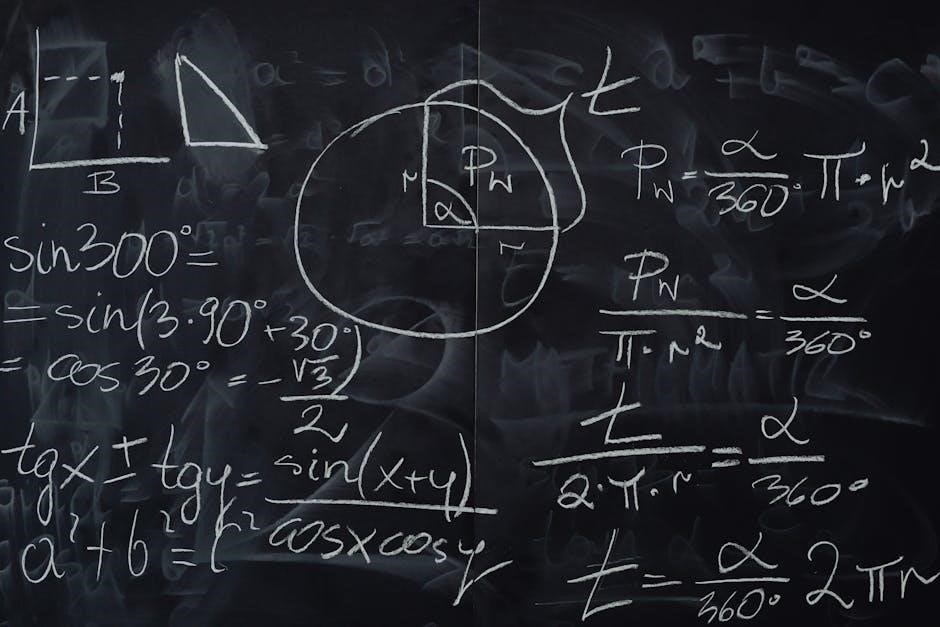
The key offers detailed explanations of how these algebraic properties apply to geometric figures and equations, bridging the gap between algebra and geometry. Students learn to manipulate equations effectively, ensuring logical consistency throughout their reasoning.
Resources like bartleby’s solutions demonstrate how to apply these properties to solve for unknown angles and segment lengths. Mastering these algebraic tools is crucial for successfully proving geometric theorems, and the solution key offers targeted practice and clarification.
2.3 Proving Theorems
Jurgensen Geometry’s strength lies in its rigorous approach to proving theorems, and the solution key is invaluable for mastering this skill. Chapter 2.3 specifically guides students through constructing logical arguments, utilizing postulates, definitions, and previously proven theorems.
The solution key breaks down complex proofs into manageable steps, clearly illustrating how each statement follows from preceding ones. It emphasizes the importance of justification, ensuring every claim is supported by a valid reason. Students learn to identify appropriate theorems and definitions to apply in different scenarios.
Resources like bartleby provide detailed solutions that serve as models for constructing their own proofs. The key helps students develop critical thinking and problem-solving skills, essential for success in geometry and beyond, offering a solid foundation for deductive reasoning.

Key Features of the Solution Key
Jurgensen Geometry’s solution key provides detailed, step-by-step solutions, clear explanations of proofs, and addresses challenging problems effectively, aiding comprehension.
Detailed Step-by-Step Solutions
The Jurgensen Geometry Solution Key excels in providing meticulously detailed, step-by-step solutions for each problem presented within the textbook. These solutions don’t simply offer the answer; they unravel the logical progression required to reach it, making the learning process transparent and effective.
Each step is clearly articulated, referencing relevant postulates, theorems, and definitions from the text. This approach is particularly beneficial for students grappling with complex geometric proofs or multi-stage problems. The key breaks down intricate concepts into manageable components, fostering a deeper understanding of the underlying principles.
Furthermore, the solutions often include illustrative diagrams and annotations, enhancing visual comprehension. This feature is invaluable for students who learn best through visual aids. By meticulously outlining each step, the solution key empowers students to independently solve similar problems and build confidence in their geometric reasoning abilities. It’s a powerful tool for both in-class review and independent study.
Explanations of Geometric Proofs
The Jurgensen Geometry Solution Key doesn’t merely present completed proofs; it meticulously explains the reasoning behind each step. This is crucial for mastering geometric deduction, as understanding why a statement is valid is as important as knowing that it is.
Each line of a proof is accompanied by a clear justification, referencing relevant postulates, theorems, or definitions. The key highlights the logical connections between statements, demonstrating how each step builds upon the previous one to reach the desired conclusion. This detailed explanation helps students identify common proof strategies and apply them to new problems.
The solution key also addresses potential pitfalls and common errors in proof construction; By anticipating these challenges, it guides students towards a more robust understanding of geometric logic. This focus on conceptual understanding, rather than rote memorization, is a key strength of the resource, fostering genuine problem-solving skills.
Addressing Challenging Problems

Jurgensen Geometry’s solution key excels at tackling particularly difficult problems, often involving spatial reasoning or multi-step deductions. It doesn’t shy away from complex scenarios, like determining planes and lines with points not lying within them – a common challenge highlighted in case studies.
The key breaks down these problems into manageable steps, clearly identifying the given information, the desired conclusion, and the logical pathway to connect them. It often employs diagrams and visual aids to enhance understanding, particularly for problems involving three-dimensional geometry.
Furthermore, the solution key provides insights into problems involving committees and clubs, demonstrating how to apply geometric principles to abstract scenarios. It emphasizes a systematic approach to problem-solving, encouraging students to carefully analyze each condition and utilize appropriate theorems and postulates.

Where to Find the Solution Key
Jurgensen Geometry’s solution key (ISBN-13: 9780395677667) is available for purchase, and online platforms like bartleby offer access to solutions.
Purchasing Options (ISBN-13: 9780395677667)
The Jurgensen Geometry Solution Key, identified by ISBN-13: 9780395677667, can be acquired through various bookselling channels. Major online retailers, such as Amazon and Barnes & Noble, frequently stock the key, offering both new and used copies. Checking these platforms provides options based on price and condition.
Additionally, educational supply stores, both physical and online, are reliable sources for obtaining the solution key. University and college bookstores may also carry it, particularly if the textbook is used in affiliated courses. Comparing prices across different vendors is recommended to secure the most favorable deal.
When purchasing, ensure the ISBN matches to guarantee you receive the correct solution key for the Jurgensen Geometry textbook. Be cautious of significantly discounted offers from unfamiliar sources, as these may indicate counterfeit or incomplete materials. A legitimate copy will provide comprehensive support for mastering the textbook’s content.
Online Resources and Platforms (e.g., bartleby)
Several online platforms offer access to Jurgensen Geometry solutions, providing students with convenient support. Bartleby, for instance, features chapter-specific solutions covering topics from points and lines to deductive reasoning. These resources often present step-by-step explanations, aiding comprehension of complex problems;
Other educational websites and tutoring services may also provide access to solutions, sometimes through subscription models. While these platforms can be valuable, it’s crucial to verify the accuracy and completeness of the provided solutions. Cross-referencing with the textbook is always recommended.
Be mindful of free online resources, as their reliability can vary. Always prioritize platforms with a strong reputation for academic integrity. Utilizing these online tools effectively complements traditional study methods, enhancing understanding and problem-solving skills in geometry.
Potential Issues with Free PDF Downloads
Downloading a Jurgensen Geometry solution key PDF from unofficial sources carries significant risks. Free PDFs found online are often incomplete, containing errors or missing crucial problem solutions. These inaccuracies can hinder learning and lead to incorrect understanding of geometric principles.
Furthermore, such downloads may violate copyright laws, posing legal consequences. Unofficial PDFs can also contain malware or viruses, compromising your device’s security. The quality of these free resources is often questionable, lacking the detailed explanations and accurate steps found in authorized materials.
Purchasing the official solution key (ISBN-13: 9780395677667) or utilizing reputable online platforms like Bartleby ensures access to reliable, accurate, and legally obtained resources. Prioritizing legitimate sources safeguards your learning and protects your digital security.

Specific Problem Areas and Solutions
The solution key addresses complex scenarios, such as determining planes and lines, and committee/club problems involving five persons, offering detailed, step-by-step guidance.
Case Studies: X Not Lying on a Plane
When point X doesn’t reside on a plane defined by points A, B, C, and D, the Jurgensen Geometry solution key meticulously details the resulting geometric implications. This scenario introduces ten new lines, expanding beyond the initial set. Furthermore, it generates seven planes established in previous cases, alongside three additional planes: (ABX), (ACX), and (BCX).
The solution key doesn’t merely present answers; it elucidates the reasoning behind them, demonstrating how these new lines and planes interact. This is particularly helpful for students grappling with spatial visualization and understanding three-dimensional geometry. The key provides a systematic approach to identifying and counting these elements, preventing common errors. It emphasizes a logical progression, building upon foundational postulates and theorems to arrive at accurate conclusions. This detailed breakdown is invaluable for mastering complex geometric problems.
Understanding Committee and Club Problems
Jurgensen Geometry’s solution key tackles intricate “committee and club” problems, often involving set theory and logical deduction. A key example highlights that if five individuals aren’t all members of the same club, there must be at least eight committees and five clubs. The solution key doesn’t simply state this result; it breaks down the logic, explaining why this is true.
These problems test a student’s ability to apply geometric principles to abstract scenarios. The key provides step-by-step guidance, illustrating how to translate the problem’s conditions into mathematical relationships. It emphasizes careful consideration of all possibilities and avoiding overcounting. Visual aids and diagrams, often included in the key, further enhance understanding. Mastering these problems builds critical thinking skills applicable beyond geometry, fostering a deeper comprehension of logical reasoning.